

Thoughts From The Divide: Front Running the Front Runners

Readers of this Substack may have noticed a recent focus on two superficially unrelated subjects: Who will succeed Jerome Powell as the next Fed Chair, and the recent apparent marginal deterioration in credit markets, particularly the private credit markets. Of course, the subjects are only superficially unrelated. It’s not entirely coincidental that problems in the credit markets have emerged after an extended (albeit gradual) period of Fed QT. We would hate for you to think we were suggesting a crude monotonic relationship between the Fed balance sheet and private sector credit availability: very few things in life or finance are that simple. But simply by running down excess reserves at the same time as building up the TGA, has resulted in repo markets tightening a bit, and, that seems to have set the stage for marginal lenders to think a little harder about their exposures, while marginal borrowers have found it a little harder to come by money with no inconvenient questions asked (Cov-lite). Let’s call it a change in the Zeitgeist.
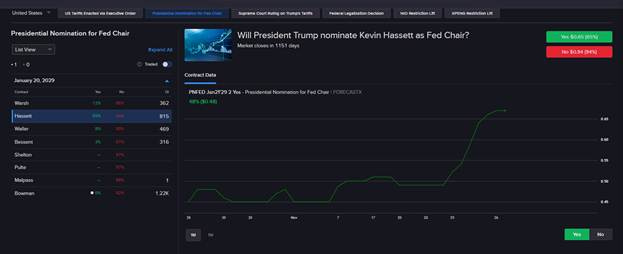
Well, the search for the next Fed chair appears to have heated up of late, and apparently it’s between the Kevins, with Hassett emerging as the frontrunner. We would argue that whether credit market conditions continue to deteriorate will be, at least partially, a function of Fed policy, and that’s why this pick matters so much. Some have argued that Trump wants a patsy at the Fed, but we suspect the Trump administration’s agenda is both far more interesting and more consequential for markets. It’s striking that some Trump appointees and leading candidates for the FOMC Chair have focused particular attention on the balance sheet and regulatory changes. We would argue that if one reads between the lines (or just the lines themselves (page 733), one can discern the outline of a far-reaching shift away from restrictive banking supervision rules introduced in the wake of the GFC towards a significant liberalization. Some have suggested that the rule changes that are coming might increase the private sector balance sheet by something of the order of $6trillion and boost banking sector profitability.
This could potentially solve a lot of problems. It’s not a secret that bank profitability (particularly for the regionals) could be better. On its own, expanding the balance sheet wouldn’t do much to help that, but if the front end of the curve was lower, the banks could “surf the curve” and earn their way out of trouble, while at the same time solving the Federal government’s difficulties in finding sufficient demand for duration. If this outcome did materialize, it would allow the much-needed consolidation of regional banking to take place from a position of strength rather than weakness.
Easier money might also rescue the private credit industry (not that they need rescuing), although cynics (nous?!) might question the terms on which credit might be available to them from potential new competitors like the major money center banks.
Shame on us, but we confess to finding Craig Packer’s interview on Bloomberg funny/hilarious.
“Packer bemoaned ‘negative articles’ about private credit that caused its stock to sink. When it comes to Blue Owl’s business development companies, the firm’s co-founder said on CNBC, “there’s no emergency here.”
In an interview with Bloomberg on Wednesday, Packer said that the fund has performed well and that Blue Owl will work with the fund’s board to figure out a liquidity solution for investors.”
As Mandy Rice-Davies (bless her) might say, “well he would, wouldn’t he”. However, in the context of headlines like this, or this or even this, it’s not that hard to see why some investors in Blue Owl funds might think now was a good time to say “so long, and thanks for all the fish”.
For what little it’s worth, our biggest concern for the private credit markets is probably the sheer volume of public issuance from high-quality names in the sector. But ultimately, concerns about most private credit markets can probably be assuaged by a sufficiently easy monetary policy, whether that easing is regulatory, or in terms of lower policy rates, or some combination of the two.
To our mind, the main question left to be resolved is whether Powell will break with tradition and stay on the board when his term as Chair is over, or leave the Board (freeing up another seat for a Trump candidate). Our suspicion is that he has not decided yet. We have no doubt in our mind that given his druthers, Powell would rather be anywhere else but we suspect his loyalty to the Fed as an institution, and his lunch buddies mean that he will try to lobby for the Fed’s preferred candidates, which we suspect would be Waller, Bauman or Hassett. Most people think it will be Hassett (we hear even Waller doubts he will get the job), and if it is, Powell will ride off into the sunset. Happy Holidays!


Black Friday Promo — 20% Off MacroCapture Annual
If you’ve been thinking about taking your macro process to the next level, now’s the moment. For Black Friday, we’re offering 20% off an annual MacroCapture subscription—giving you full access to MI2’s actionable market insights, strategic frameworks, and timely updates that keep investors ahead of major shifts.
Use code MACRO20 at checkout and lock in a full year of research at a rare discount.